

What Makes a Good Dashboard Camera? The Ultimate 2026 Buying Guide
Bleat
A dashboard camera that fails under the 48°C heat of scorching summer days isn't a safety tool; it's an expensive paperweight. You already know that Indian roads are unpredictable, and having a reliable witness is no longer optional for your peace of mind. However, with hundreds of generic gadgets flooding the market, finding a truly good dashboard camera feels like a gamble between technical jargon and actual performance.
This guide cuts through the marketing noise to reveal the critical hardware specs, from Starvis 2 sensors to OBD based connectivity, that ensure your vehicle is protected by India's No. 1 technology. You'll learn how to secure crystal clear 4K evidence for insurance claims without worrying about complicated wiring or battery drain. We are breaking down the essential 2026 features including superior heat resistance, smart app integration, and the "set and forget" automation that defines a premium driving experience. It's time to stop settling for basic tech and start making smarter choices. Travel with Bleat and upgrade your security today.
Key Takeaways
- Learn why native 4K resolution and Sony Starvis 2 sensors are now mandatory for capturing clear number plates in chaotic traffic.
- Discover the safety advantages of supercapacitors over standard batteries to ensure your device survives the extreme Indian heat.
- Understand what features define a good dashboard camera in 2026 to guarantee your vehicle has a reliable digital witness.
- Explore how OBD-II based connectivity offers the most secure and efficient way to power your dashcam without complex wiring.
- Identify the essential smart features and app integrations that allow for instant evidence sharing and seamless travel protection.
Defining a 'Good' Dashboard Camera for 2026
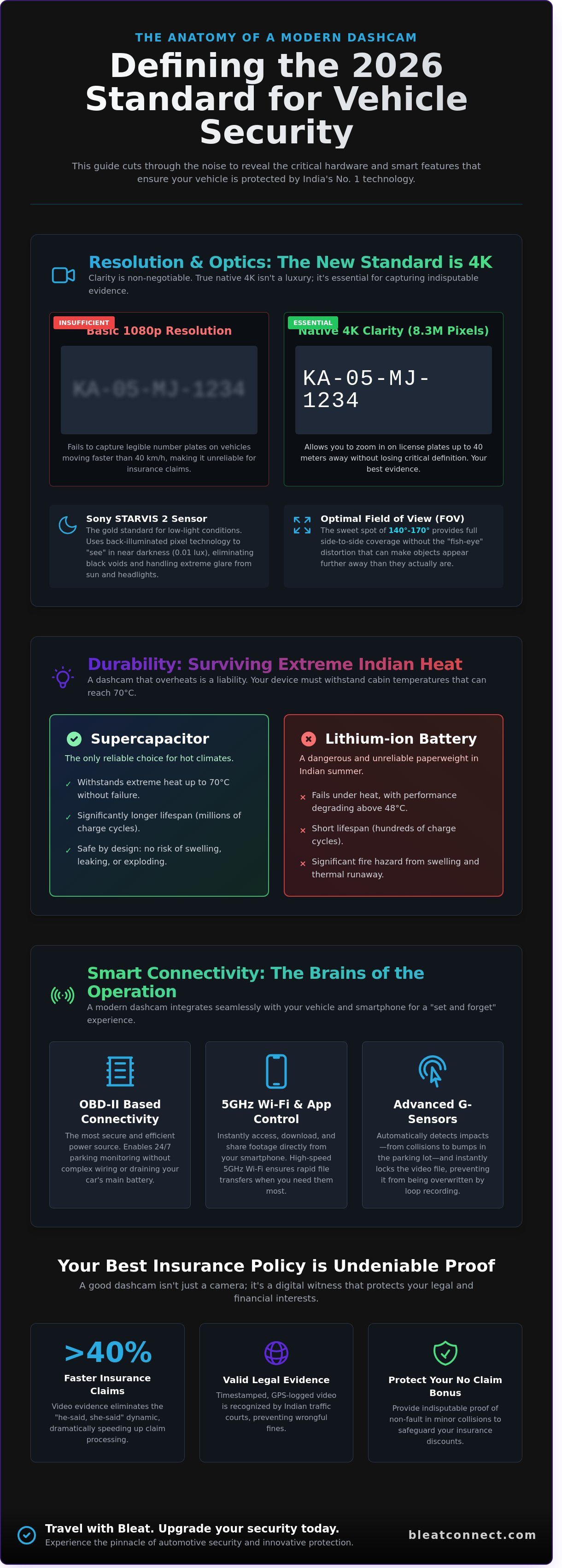
Modern Indian roads demand more than just a basic recording device. As traffic density increases in cities like Bengaluru and Delhi, the role of a dashcam has evolved into that of a high-tech digital witness. Understanding what a dashboard camera is helps drivers realize it's no longer just a hobbyist gadget. It's a critical safety component. By 2026, the standard for a good dashboard camera has shifted from simple 1080p video to comprehensive 4K smart systems. Basic 1080p resolution often fails to capture legible license plates when vehicles move faster than 40 km/h, making it insufficient for modern insurance requirements.
The distinction between a generic 'car camera' and a 'smart dashboard security system' lies in the integration of AI and hardware reliability. A premium system doesn't just record; it protects. We define the quality of these systems through four essential pillars:
- Optics: High-resolution sensors like Sony Starvis 2 that handle the extreme glare of Indian summer sun and low-light highway driving.
- Durability: Supercapacitor-based power systems that withstand cabin temperatures reaching 70°C without swelling or failing.
- Storage: Efficient H.265 compression and support for high-endurance microSD cards up to 512GB.
- Connectivity: Seamless integration via 5GHz Wi-Fi and specialized OBD-based power for 24/7 monitoring.
Why reliable evidence is your best insurance policy
Insurance companies in India are increasingly prioritizing video evidence to settle disputes. Footage from a good dashboard camera can reduce claim processing time by over 40% by eliminating the "he-said, she-said" dynamic common in road accidents. Indian traffic courts now recognize timestamped, GPS-logged video as valid evidence under the Bharatiya Sakshya Adhiniyam. To augment this data with real-time alerts and location history, a GPS tracker for car from Letstrack is a highly recommended addition. This visual proof prevents wrongful fines and protects your No Claim Bonus (NCB) during minor collisions. A dashcam is the ultimate tool for road accountability in 2026, providing an indisputable visual record that protects your legal and financial interests.
The shift from basic recording to smart protection
Old-school cameras relied on manual intervention. Modern Bleat systems use advanced G-Sensors to detect impacts and instantly lock footage into a secure folder, preventing it from being overwritten during loop recording. Urban safety requires more than just drive-time footage. With 24/7 parking monitoring, your vehicle remains protected against hit-and-runs while parked in public lots or residential complexes. As India's No.1 tech-forward dashcam brand, we focus on OBD-based connectivity to ensure your car's battery stays safe while providing continuous surveillance. It's about an end-to-end user experience where the hardware works silently in the background. Travel with Bleat to experience the pinnacle of automotive security and innovative protection.
Resolution and Optics: Why 4K Clarity is the New Standard
Clarity is the ultimate currency in road safety. Don't be fooled by marketing labels. Many budget devices claim 4K resolution but rely on software interpolation to upscale grainy 1080p footage. True native 4K delivers 8.3 million pixels of data. This allows you to zoom in on a license plate 40 meters away without losing definition. A good dashboard camera must provide this level of evidentiary detail to be useful in legal or insurance disputes. In the chaotic flow of Indian traffic, the difference between a blurry shape and a readable digit is everything. Industry experts now suggest that 4K clarity is the new standard for drivers who prioritize absolute security.
Field of View (FOV) also dictates how much of the "story" your camera captures. While some brands push for fish-eye lenses over 180°, these often distort distances and make objects appear further away than they are. The sweet spot for Indian roads is between 140° and 170°. This range provides full side-to-side coverage, capturing pedestrians or cyclists entering your lane from the periphery without warping the image quality at the edges.
The science behind low-light performance
Night driving in India presents unique challenges, from unlit rural roads to blinding high-beams in urban centers. The Sony Starvis 2 sensor is the current gold standard for these conditions. It uses back-illuminated pixel technology to mimic human eye sensitivity, effectively "seeing" in near-darkness at levels as low as 0.01 lux. This sensor ensures that shadows don't become black voids in your footage. To eliminate motion blur during high-speed highway transit, 60FPS (frames per second) is vital. It doubles the image data compared to standard 30FPS cameras, freezing fast-moving objects in sharp focus. WDR technology balances exposure when driving under bright streetlights or entering tunnels, preventing the sensor from being overwhelmed by sudden light changes.
Front and rear: the dual-channel advantage
A single perspective isn't enough. Recent traffic data indicates that 30% of road incidents involve rear-end collisions or "hit and run" attempts from behind. A dual-channel system records two high-definition streams simultaneously, providing a 360-degree shield of protection. Managing these heavy data streams requires a high-performance processor to ensure the footage remains synchronized and skip-free. For most Indian car owners, an external rear-view camera is preferred to avoid the signal interference caused by heavy window tints. Internal cabin cameras are a specialized alternative, perfect for ride-hailing drivers who need to document interior interactions for safety. Bleat remains India's No.1 choice by combining these high-end optics with OBD based Connectivity for a seamless user experience. Travel with Bleat to ensure every angle of your journey is protected by good dashboard camera technology.
Reliability in Extremes: Surviving Heat and Erratic Traffic
India presents a brutal environment for vehicle electronics. Inside a car parked under the April sun in Rajasthan or Chennai, cabin temperatures easily exceed 70°C. A good dashboard camera isn't just about video quality; it's about survival. Standard consumer electronics often rely on lithium-ion batteries, which pose a significant fire risk in these conditions. High heat causes lithium cells to swell, leak, or even ignite, potentially damaging your vehicle's interior. Choosing hardware built specifically for the Indian climate ensures your investment doesn't become a safety hazard.
Supercapacitors vs. Lithium-Ion batteries
Investing in a good dashboard camera equipped with a supercapacitor is the only way to ensure 24/7 protection in the tropics. Unlike batteries that store energy chemically, capacitors store it electrostatically. This allows them to operate reliably in temperatures ranging from -20°C to over 75°C without the risk of thermal runaway. They eliminate the "swollen battery" syndrome that plagues cheap imports after just six months of use. While a battery might fail to save the last clip during a power cut, a supercapacitor provides the necessary burst to finalize recordings safely every time. It's a critical safety feature for any driver prioritizing long-term reliability.
The hardware that handles the vibration
Indian roads demand rugged construction. From monsoon-damaged highways to unpaved rural tracks, constant vibration can loosen internal components or cause blurry, unusable footage. Professional-grade cameras utilize reinforced polycarbonate or metal housings to dissipate heat and maintain structural integrity. This build quality extends to the mounting system. High-bond 3M adhesive mounts outperform traditional suction cups, which often lose grip and fall off when the windshield heats up during the day.
- Shock-resistant mounting: Secure, low-profile attachments prevent "image jelly" and keep footage steady even on the bumpiest terrain.
- G-Sensor calibration: Advanced sensors distinguish between a deep pothole and a genuine collision, preventing your storage from filling up with "locked" clips of bad roads.
- High Endurance storage: High Endurance SD cards are mandatory for constant 4K rewriting because standard cards fail under the intense read-write cycles of continuous loop recording.
Reliability is the backbone of the Bleat philosophy. As India's No. 1 dashcam brand, we engineer products to thrive where others fail. Our systems integrate seamlessly with OBD-based connectivity to provide a stable power source that bypasses traditional battery weaknesses. Don't settle for fragile gadgets that quit when the mercury rises. Travel with Bleat and experience the peace of mind that comes with hardware designed for the real-world challenges of the Indian subcontinent.
Smart Connectivity: The Advantage of OBD and App Control
Modern driving in India demands more than just a recording device. A good dashboard camera must act as a seamless extension of your digital life. Bleat leads this shift by moving away from clunky, outdated power methods toward intelligent, integrated ecosystems. This connectivity ensures your evidence is accessible, your car is protected, and your warranty remains intact.
The revolution of OBD-II power
Traditional dashcams rely on cigarette lighter sockets or risky fuse box hardwiring. Bleat's signature OBD based Connectivity eliminates these compromises. The OBD-II port provides a constant power source that is 100% plug-and-play. You don't need to cut wires or visit a mechanic. This method is essential for 24/7 parking mode. While cigarette lighters shut off with the engine, the OBD connection keeps the G-Sensor active. It detects impacts even when you are away from the vehicle.
Safety extends to your car's battery health. Bleat smart OBD cables feature built-in voltage protection. The system monitors the battery level in real-time. If the voltage drops below a threshold, such as 11.8V or 12.4V, the camera shuts down automatically. This prevents battery drainage, ensuring your engine cranks every time. It's the most reliable way to power a good dashboard camera in the Indian climate where heat can stress vehicle electronics.
- Zero Wire Cutting: Keeps your manufacturer warranty valid.
- Instant Setup: Installation takes less than 30 seconds.
- Smart Shutdown: Prevents deep discharge of the car battery.
Managing footage with a smartphone
The days of removing tiny SD cards to view footage are over. The Bleat app provides a high-speed interface for your smartphone. Utilizing 5GHz Wi-Fi protocols, users experience 30% faster download speeds compared to standard 2.4GHz connections. You can stream 4K files directly on your screen without lag. This is critical for showing evidence to traffic police or insurance adjusters on the spot.
Software longevity is handled through OTA (Over-The-Air) updates. Just like a smartphone, your Bleat dashcam receives performance patches and new features automatically through the app. This ecosystem also supports GPS logging. Every second of video is embedded with metadata, including your exact coordinates and speed. In a legal dispute, this data serves as an indisputable digital footprint of your journey.
Voice controls add a final layer of safety. Indian roads require constant focus. You can trigger emergency locks or take photos using simple voice commands. This keeps your hands on the wheel while the tech handles the documentation. It's about protection without distraction.
Ready to upgrade your vehicle with India's No.1 dashcam technology? Travel with Bleat and experience the future of road safety.
Why Bleat 4K is the Best Dashboard Camera Choice
Finding a good dashboard camera in India requires a balance between high-end optics and extreme durability. Bleat 4K represents the perfect intersection of premium technology and Indian road ruggedness. It's engineered to survive 48-degree Celsius summers while capturing every detail of chaotic city traffic. We don't just sell hardware; we provide a safety ecosystem designed for the modern Indian driver.
The "Travel with Bleat" philosophy frames safety as a lifestyle, not just a feature. It's about the confidence that comes from knowing India's No.1 dashcam brand has your back. Our national support network and comprehensive warranty ensure you're never stranded with a failing device. You're investing in a product from a leader that understands local regulations and driving conditions perfectly.
This commitment to safety often extends to our furry passengers as well. For pet owners who value the same level of technical precision in their pet's training as they do in their car's security, Educator Collars offers advanced remote systems to keep your companions safe and well-behaved on the road.
The Bleat 4K technical edge
The Bleat 4K Dashcam Pro features the cutting-edge Sony Starvis 2 sensor. This hardware delivers 4K clarity, making license plates legible even on unlit highways at night. The heat-resistant architecture uses supercapacitors instead of lithium batteries, preventing swelling in parked cars under the sun. Our unique OBD based Connectivity simplifies installation and ensures your car's warranty remains intact.
- 4K Ultra HD: 3840 x 2160p resolution for maximum evidence clarity.
- Starvis 2 Sensor: Exceptional low-light performance and dynamic range.
- G-Sensor Tech: Automatic impact locking to protect crucial footage.
- Award-Winning Design: A sleek profile that complements premium car interiors.
Real-world results prove our value. In 2023, a Bleat user in Delhi saved over ₹30,000 in potential damages by proving a cyclist swerved into their lane. These aren't just gadgets. They're digital witnesses that provide absolute truth when you need it most. Investing in a good dashboard camera is the smartest upgrade you can make for your vehicle this year.
Taking the next step for your safety
Deciding between our models is simple. Choose the Bleat 4K if you frequently drive on highways or want the absolute best image quality available. The 3K model offers a fantastic balance for daily city commutes. Both integrate seamlessly into our smart ecosystem, providing instant access to footage via your smartphone. To ensure you receive genuine hardware and the latest firmware updates, always purchase directly from our official digital storefront.
Don't leave your safety to chance on unpredictable roads. Protect your journey with India's No.1 Bleat 4K Dashcam and experience the peak of automotive connectivity today.
Secure Your Journey With 2026 Standard Tech
Choosing a good dashboard camera for 2026 requires looking beyond basic recording. True protection demands 4K clarity powered by the Sony Starvis 2 sensor to capture license plates in challenging low-light conditions. It's essential to select hardware built specifically for the 50-degree Celsius Indian climate and erratic road behaviors. Modern drivers now prioritize OBD-based connectivity because it eliminates messy hardwiring while providing constant power for 24/7 parking surveillance.
Bleat stands as India's No.1 Tech Brand, already trusted by over 100,000 Indian drivers to safeguard their daily commutes. Our 4K systems integrate cutting-edge optics with smart app controls, ensuring you have instant access to footage when every second counts. We've engineered our devices to be the ultimate companion for the modern traveler, blending high-level technical specs with practical safety benefits. It's time to move past entry-level gadgets and embrace a professional-grade security ecosystem that leads the industry.
Upgrade to India's No.1 Bleat 4K Dashboard Camera today
Travel with Bleat and enjoy the confidence of knowing your vehicle is protected by the most advanced technology on the road.
Frequently Asked Questions
Is a dashboard camera legal in India for personal use?
Yes, using a dashboard camera for personal safety is completely legal in India. No Motor Vehicle Act provision restricts the use of recording devices inside private vehicles. Law enforcement often encourages their use to help resolve road disputes quickly. A good dashboard camera acts as a silent witness, providing 100% objective evidence during traffic stops or accidents on chaotic Indian roads.
Can a dashcam record while the car is parked and turned off?
Yes, your dashcam can record while parked if it features a dedicated Parking Mode. This requires a constant power source through an OBD-II port or a hardwire kit. Bleat’s innovative OBD based Connectivity ensures the camera monitors your vehicle 24/7 without messy wiring. The G-sensor detects impact and triggers an instant recording to capture hit-and-run incidents while you are away from the vehicle.
How much storage space does a 4K dashcam need for a long trip?
A 4K dashcam typically requires 128GB of storage for 6 hours of continuous footage at high bitrates. 4K files are massive, often consuming 300MB to 500MB per minute of video. For a 12-hour road trip across India, we recommend a 256GB Class 10 U3 SD card. This ensures you have enough space for high-resolution 2160p captures before the loop recording process begins.
Do I need professional installation for a front and rear dashcam?
Professional installation is highly recommended for dual-channel setups to ensure clean cable management and reliable power. While front cameras are often plug-and-play, rear units involve routing 6-meter cables through the roof lining or floor mats. Experts ensure the G-sensor is calibrated and the OBD connection is secure. This professional touch maintains your car's aesthetic and guarantees the system functions perfectly during critical emergencies.
Does a dashcam drain the car battery if left plugged in?
A dashcam won't drain your battery if you use a smart power management system. Modern kits include a built-in voltage cutoff that stops drawing power if the battery drops below 11.8V. This ensures your engine always has enough juice to start. Bleat’s cutting-edge OBD connectivity provides this protection automatically, making it an essential upgrade for any modern Indian car owner concerned about battery health.
What happens to the footage when the SD card is full?
Most modern units use loop recording to automatically overwrite the oldest unprotected files when the SD card reaches capacity. You don't have to manually delete footage to make room for new recordings. However, the G-sensor automatically locks files during sudden impacts or hard braking. These locked files stay safe from being overwritten until you manually format the card or download them via the smartphone app.
Can dashcam footage be used as evidence for an insurance claim?
Yes, Indian insurance companies and courts increasingly accept dashcam footage as primary evidence for claims. Digital records provide a clear timeline of events, which can speed up claim settlements by 40% in many cases. Having a good dashboard camera prevents "he said, she said" scenarios. It protects your No Claim Bonus (NCB) by proving you weren't at fault during a collision.
Is a 4K dashcam significantly better than a 1080p one?
A 4K dashcam offers 4 times the pixel density of a standard 1080p unit, making it significantly better for capturing details. In Indian lighting conditions, 3840x2160 resolution is vital for reading license plates from 20 feet away. When paired with Starvis2 sensors, 4K clarity provides superior night vision. It’s the difference between seeing a blurry shape and identifying a specific vehicle number. Travel with Bleat for maximum clarity.